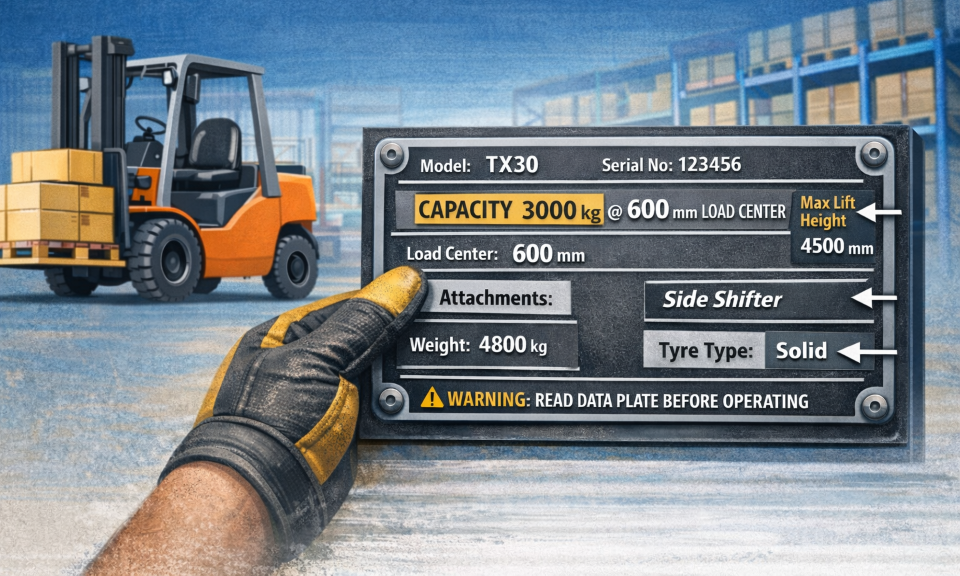
Every forklift has clear operating limits, and those limits are defined on the forklift data plate. This small metal plate is one of the most important safety features on any forklift, yet it is often misunderstood or ignored. Knowing how to read a forklift data plate is essential for preventing tip overs, avoiding overloading, and meeting workplace safety obligations in Australia.
A forklift data plate sets out the manufacturer approved capacity of the machine under specific conditions. It explains how much weight the forklift can safely lift, how high it can lift it, and under what configuration that capacity applies. Importantly, the data plate forklift information must always be read as a whole. Focusing on a single number without understanding the context can lead to unsafe decisions.
What Is a Forklift Data Plate?
A forklift data plate is a permanently fixed plate fitted to a forklift by the manufacturer or an authorised engineer. It displays the forklift’s rated capacity and operating limits based on a defined configuration.
You may also hear it referred to as a data plate for forklift, capacity plate, or nameplate. Regardless of the term used, its purpose is the same. It tells the operator exactly how the forklift must be used to remain safe and compliant.
The information on the plate is not a guideline or recommendation. It is a certified limit based on engineering design, stability testing, and regulatory requirements.
Where to Find the Data Plate on a Forklift
On most counterbalance forklifts, the data plate is mounted inside the operator compartment. Common locations include the dashboard area, near the steering column, or on the overhead guard leg.
On other forklift types, the location can vary. Reach trucks and pallet stackers often have the plate mounted near the operator console. Rough terrain forklifts may have it positioned near the seat or control panel.
If a data plate is missing, damaged, or unreadable, the forklift should not be operated until it is replaced. Operating without a readable plate is a safety and compliance issue.
Also Read: What Licences and Training Do You Need to Operate a Hired Forklift?
Legal and Workplace Safety Requirements in Australia
Under Australian work health and safety requirements, forklifts must be operated within the limits specified by the manufacturer. The data plate is the formal record of those limits.
Employers are responsible for ensuring forklifts are maintained, correctly configured, and fitted with accurate data plates. Operators are responsible for reading and following the information on the plate before lifting a load.
Using a forklift without a data plate, or exceeding the plate’s limits, exposes both operators and businesses to serious risk and potential penalties.
What Information Is Shown on a Forklift Data Plate
While layouts vary by manufacturer, most forklift data plates include the same core information.
- Rated capacity
- Load centre distance
- Lift height
- Mast type or configuration
- Attachment allowances
- Tyre type
- Forklift model and serial details
Each of these elements works together. A forklift is only rated to lift a specific weight at a specific height and load centre, with a specific mast and attachment setup.
Rated Capacity: What the Number Really Represents
Rated capacity is the maximum load the forklift can safely lift under the exact conditions shown on the plate. This figure assumes the forklift is correctly configured and the load matches the stated parameters.
A common mistake is assuming the forklift can always lift this weight in every situation. In reality, rated capacity applies only when all listed conditions are met.
This is where many operators confuse lifting ability with stability. A forklift may be able to raise a load hydraulically but still be unsafe to operate. For a deeper explanation of how capacity changes under different conditions, see what Is residual capacity.
Load Centre and Distance
The data plate will specify a load centre distance, which relates to how the load’s weight is distributed on the forks. This value is critical to stability, but it is often misunderstood.
At a high level, longer or uneven loads move weight further forward, reducing safe capacity. Read more about forklift load centre distance here, and a particular scenario where 1,500kg may become unsafe at 800mm.
Lift Height and Mast Configuration
Lift height is another key factor shown on the forklift data plate. As lift height increases, forklift stability decreases. This is why capacity ratings often reduce at higher mast extensions.
Different mast types, such as duplex or triplex masts, affect how and when capacity changes. The data plate reflects the mast fitted to the forklift at the time it was rated.
Operators must ensure the lift height shown on the plate matches the height at which they intend to place the load.
Attachments and Capacity Derating
Forklift attachments such as sideshifters, clamps, jibs, or fork extensions all affect capacity. These attachments change the forklift’s centre of gravity and increase leverage on the front axle.
If a forklift is fitted with an attachment, the original data plate may no longer be valid. An updated plate must be issued that reflects the reduced capacity.
Operating with attachments without an updated data plate is a common and serious safety breach.
How to Read a Forklift Data Plate Step by Step
Before lifting any load, operators should follow a simple process.
- Check the rated capacity on the data plate
- Confirm the load centre distance matches the load
- Check the lift height required
- Confirm the mast and attachment configuration
- Ensure tyre type matches the plate
- Assess whether all conditions align with the load being lifted
If any condition differs, the rated capacity no longer applies.

Common Forklift Data Plate Mistakes to Avoid
- Relying on memory instead of checking the plate
- Assuming all loads behave the same
- Ignoring configuration changes
- Confusing lifting ability with safe operation
- Using forklifts with missing or outdated plates
These mistakes are a leading cause of forklift incidents and tip overs.
Also Read: Forklift Stability Triangle & Turning, Braking and Uneven Loads (Real Scenarios)
What to Do If a Load Exceeds the Data Plate Rating
If the load exceeds the data plate rating, the solution is never to push the limits. Safer options include reducing the load size, using a forklift with higher capacity, changing the attachment, or selecting different equipment altogether.
The data plate exists to prevent incidents, not slow down operations.
Operator Responsibility and Ongoing Training
Reading and understanding the forklift data plate is a core operator skill. Training should emphasise not just what the numbers say, but how they apply in real workplaces.
Refresher training is particularly important when operators move between different forklift types or work environments.
Why the Data Plate Should Always Come First
The forklift data plate is the single most important reference for safe operation. It defines the true limits of the machine and removes guesswork from lifting decisions.
By understanding how to read a forklift data plate and respecting its limits, operators and site managers can significantly reduce risk, improve compliance, and prevent costly incidents.
Heavy Lift Forklifts
Our showroom: 826 Mountain Hwy, Bayswater VIC
Call us on: (03) 9762 4965