Two forklifts can share the same engine, the same lift capacity, and the same brand badge on the mast, and still behave completely differently the moment they roll onto uneven ground. Often, the difference comes down to something as simple as what is touching the floor.
Choosing between solid vs pneumatic forklift tyres is not just a maintenance detail. It shapes how a forklift handles, how comfortable it is to operate, and how well it holds up to the specific ground it works on every day.
What’s Actually Different Between the Two
Understanding forklift tyres types start with a simple distinction: one is filled with air, the other is not.
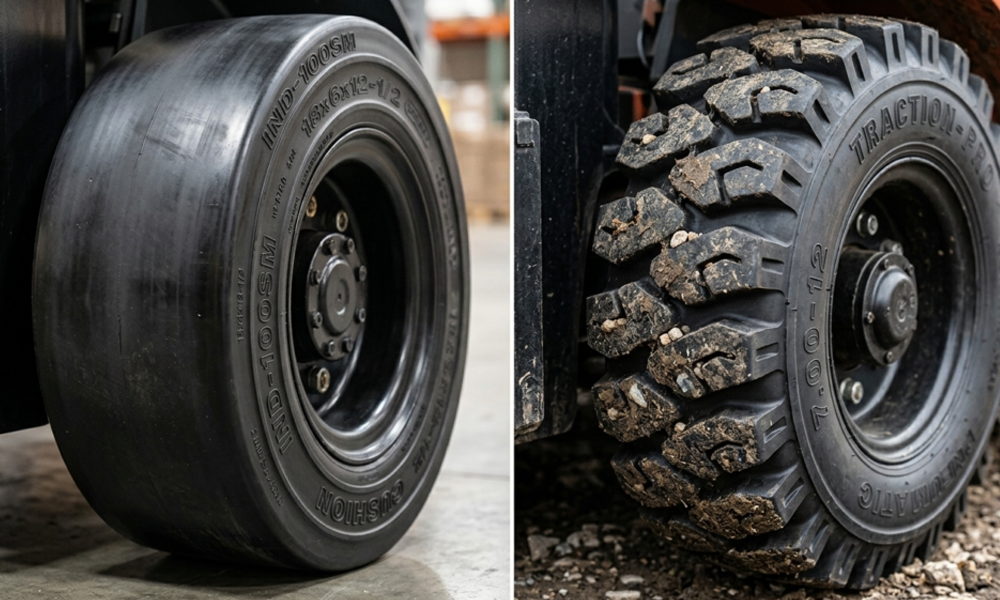
Pneumatic tyres are air filled, similar in principle to a truck tyre, with deep tread designed to grip loose or uneven surfaces. They flex under load, absorbing bumps, and rough patches rather than transmitting every jolt straight into the mast.
Solid tyres are exactly what the name suggests, moulded from solid rubber or polyurethane with no air chamber at all. There is nothing to puncture and nothing to go flat, which makes them a genuinely different proposition for sites where downtime from a blown tyre simply is not an option.
That single difference, air versus no air, ends up shaping everything else: ride comfort, puncture risk, load stability, and how each tyre performs once the site gets muddy, gritty, or uneven.
Also Read: Parts of a Forklift and Their Function
Where Pneumatic Tyres Earn Their Keep
Pneumatic tyres are usually the better fit once a forklift spends real time outdoors, and it is worth knowing exactly why:
- Rough or uneven ground. The tread and flex handle gravel, dirt, and broken pavement far more comfortably than a rigid tyre ever could.
- Longer outdoor shifts. The air cushioning reduces vibration transferred to the operator, which matters over a full day behind the wheel.
- Wet or loose surfaces. Deeper tread patterns grip better in mud, sand, or light rain, conditions that are common on construction sites and outdoor yards.
- Higher speeds. Pneumatic tyres tend to manage more comfortably at speed, useful for larger outdoor sites where forklifts cover real distance.
If your site genuinely fits the description best forklift tyres for outdoor use, pneumatic is very often the category that comes up first, and for good reason. The trade-off is that they can puncture, and a punctured tyre on a busy site is downtime nobody planned for.
Where Solid Tyres Take the Lead
Solid tyres shine in a diverse set of conditions, mostly indoors or on surfaces that are already smooth and predictable:
- Warehouse and factory floors. Flat, clean concrete does not need the shock absorption pneumatic tyres are built for, so solid tyres can do the job just as well without the puncture risk.
- High traffic, continuous use environments. No air chamber means no flats, which matters enormously in operations running multiple shifts back-to-back.
- Sites with sharp debris. Metal shavings, nails, and general workshop clutter are far less of a threat to a solid tyre than a pneumatic one.
- Lower long-term maintenance. With nothing to inflate or monitor for pressure loss, solid tyres tend to need less routine attention over their working life.
The catch is comfort. Solid tyres transmit more vibration straight through to the operator and the load, which is rarely an issue on smooth concrete but becomes noticeable fast on rougher outdoor terrain.
Matching the Tyre to the Site
The honest answer to “which is better” is that it depends entirely on where the forklift works, and a few straightforward questions tend to settle it:
- Is the surface mostly indoors and flat, or outdoors and uneven?
Flat and indoors leans solid. Outdoor and uneven leans pneumatic.
- How much does puncture risk matter to your operation?
A single flat tyre on a 24-hour warehouse floor can be a bigger disruption than the same flat on a quieter outdoor yard with a spare forklift on hand.
- How long are the shifts, and how far does the forklift travel?
Longer shifts and more ground covered tend to favour the comfort pneumatic tyres provide.
- What is on the ground?
Gravel and mud favour tread. Metal shavings and nails favour solid rubber with nothing to puncture.
Plenty of operations end up running both, solid tyres on forklifts that live inside the warehouse, and pneumatic tyres on units that spend their days out in the yard or on site. Matching tyre to task, rather than picking one type for the whole fleet, is usually what gets the most out of the equipment.
Also Read: Forklift Tynes or Tines
Fitting the Right Tyres to the Right Machine
Getting this right is not about the tyre itself, it is also about the forklift wearing it. Machines like Linde forklifts are available across a range of configurations, and matching the right tyre type to the right model makes a genuine difference to how the machine performs on your specific site.
A well-matched pairing tends to run smoother, last longer, and need far less attention along the way, exactly the outcome most operations are after.
Getting the Choice Right from the Start
There is no single answer to solid vs pneumatic forklift tyres that works for every site. What matters is being honest about the ground your forklift spends its day on, how much puncture risk your operation can comfortably absorb, and how long your shifts really run.
Get that assessment right, and the tyre choice tends to sort itself out from there, quietly supporting smoother operation rather than becoming a problem down the track.
Frequently Asked Questions
Solid tyres generally last longer, especially on smooth indoor floors, since there’s no air pressure to lose and less flexing wear over time. Pneumatic tyres tend to wear faster on rough or abrasive outdoor ground.
Solid tyres usually cost more per tyre initially. That gap often narrows over the life of the tyre, though, since solid tyres need replacing less often and carry no puncture-repair costs.
Often yes, provided the wheels and rims are compatible, though it’s worth checking with a supplier first rather than assuming any forklift can make the switch without adjustment.
A little. Solid tyres feel more rigid through turns, which some operators prefer for precision at low speed, while pneumatic tyres offer a softer, more cushioned turning feel, particularly noticeable on rougher ground.
Yes. Foam-filled pneumatic tyres keep the tread and cushioning of a standard pneumatic tyre while removing the puncture risk, at a higher cost than either standard option.
At Heavylift Forklift, we help businesses match the right equipment and tyre setup to the way their site works, from forklifts through to the tyres that keep them moving.