Buying a used forklift can look like an easy way to save money. And in many cases, it is. But the gap between a good deal and a costly mistake is smaller than most people expect. Two machines can look almost identical on the surface, yet one will run reliably for years while the other starts causing issues within weeks.
The tricky part is knowing what actually matters when you’re standing in front of a forklift. It’s not just about hours on the clock or how clean it looks. Condition, past use, and how well it’s been looked after all play a bigger role than most buyers realise.
Do you know what to pay attention to before you commit? Keep reading to find out more, avoid downtime, unexpected repair costs, and buying something that doesn’t do the job.
Why Buying Used Can Make Sense (And When It Doesn’t)
A used forklift can be a smart move when it lines up with how you actually plan to use it. If the machine is only needed for a few hours a day, as a backup unit, or for short-term work, there is often no reason to pay for something brand new. You can get solid performance at a lower upfront cost, and in many cases, the machine has already taken its biggest depreciation hit.
It also makes sense when you know exactly what you need. If your loads, lift heights, and working environment are consistent, a well-matched used forklift can do the job without overcomplicating things.
Where things change is when the forklift is going to be pushed hard every day. High-hour usage, tight deadlines, and demanding environments tend to expose wear much faster. What looked like a saving upfront can turn into ongoing repairs, downtime, and lost productivity.
This is also where the source of the forklift matters. A privately sold machine might be cheaper, but you are taking on all the risk. On the other hand, buying from a supplier that properly inspects and services their forklifts can remove a lot of that uncertainty. For example, a fully serviced, OHS-compliant forklift that has been checked over before sale gives you a much clearer starting point. Add in ongoing support like mobile repairs and maintenance, and it becomes a lot easier to keep things running without unexpected disruptions.
If you are operating across Melbourne, practical factors like support and delivery also come into play. Having access to a local team and options like metro delivery can make the process smoother and reduce downtime from day one.
There is also the question of how long you plan to keep it. If the forklift is meant to be part of your operation for years, the gap between buying used and buying new starts to close. Reliability, warranty, and lower maintenance become more important over time.
The decision is not just about price. It comes down to how the forklift will be used, how much risk you are willing to take on, and whether short-term savings outweigh long-term costs.
Start With Your Actual Requirements (Not the Price Tag)
Before you even look at a specific used forklift, take a step back and think about the job it needs to do. This sounds obvious, but a lot of buyers skip it and end up trying to make the wrong machine work.
- Start with your day-to-day loads. Not the heaviest thing you might lift once in a while, but what the forklift will handle most of the time. Weight is one part of it, but so is the shape and size of the load. Long or uneven loads put more strain on the machine and change what it can safely lift.
- Lift height is another one that catches people out. It’s not just about reaching the top rack. You want enough headroom so the forklift isn’t always working at its limit. If you’re operating in tighter spaces, mast height and clearance also come into play.
- Then think about where it will be used. Indoor work, outdoor yards, smooth concrete, rough ground, narrow aisles. Each setting changes what type of forklift makes sense. Electric units suit indoor use well, while LPG or diesel are often better for outdoor or heavier work.
The reason this matters when buying used is simple. You don’t get the option to order something built to spec. You’re choosing from what’s available. If you’re clear on your requirements first, it becomes much easier to rule out machines that won’t suit, even if they look like a good deal at first glance.
When you’re dealing with a supplier like Heavy Lift Forklifts, this is something that won’t be glossed over. You’ll be asked the right questions upfront so you don’t end up with a machine that’s not suited to your work. It’s a small step, but it makes a big difference once the forklift is on site and expected to perform.
Getting this part right early saves you from forcing a forklift into a job it wasn’t meant for, which is where most problems start.
Hours vs Condition: What Really Tells You More
One of the first things people ask when buying a used forklift is, “How many hours has it done?” It’s a fair question, but it doesn’t tell the full story.
Hours give you a rough idea of usage, but they don’t show how that time was spent. A forklift with higher hours that’s been used for light warehouse work and serviced regularly can be in far better shape than a low-hour machine that’s been pushed hard, overloaded, or poorly maintained.
This is where people often start looking at terms like “used” and “refurbished”. A used forklift simply means it’s had a previous owner. A refurbished one has had work done to bring it back to a better standard. The catch is that “refurbished” can mean very different things depending on who’s selling it. Sometimes it’s a proper mechanical going-over. Other times it’s little more than a clean-up and basic service.
That’s why condition matters more than both the hours and the label. What you want to know is what’s actually been done to the forklift before it gets to you.
When you’re looking at a machine, focus on how it runs, how it lifts, and how it feels to operate. Check for wear in key areas like the mast, forks, tyres, and hydraulics. A forklift that’s been looked after usually shows it straight away.
This is also where buying from the right supplier makes a difference. For example, when a forklift has been fully serviced and brought up to OHS compliance before sale, you’re not taking on the same level of risk as buying something straight off a private seller. It means the machine has already been checked over properly and is ready to go to work.
Service history plays a big role here as well. Regular maintenance, recorded properly, is often a better sign than a low hour count on its own.
At the end of the day, the goal isn’t to find the forklift with the lowest hours or the best-sounding label. It’s to find one that’s been used in the right way, properly maintained, and prepared for its next job. That’s what will keep it running once it’s on your site.
Also Read: What is a telehandler?
Engine, Battery, and Key Components
This is where the real cost sits. You can overlook a few cosmetic issues on a used forklift, but if the engine, battery, or core components are worn out, it won’t take long before you’re spending money.
- Start with the power source.
- If it’s an electric forklift, the battery is the big one. Ask how old it is, how it’s been charged, and how long it holds a charge in real use. A tired battery might still work, but it won’t last through a full shift, and replacement costs aren’t small. Slow charging, short run time, or inconsistent power are all signs it’s on the way out.
- For LPG or diesel forklifts, pay attention to how the engine starts and runs. It should start cleanly without struggling. Excess smoke, rough idling, or hesitation under load can point to wear or poor maintenance. These are the kinds of issues that don’t fix themselves.
2. Then look at how the forklift actually drives and operates.
- The transmission should feel smooth, not jerky or delayed.
- Brakes should respond properly without needing extra pressure.
- Steering should feel controlled, not loose or unpredictable. These things are easy to test and often give away underlying problems.
3. Hydraulics are another key area.
- Lifting should be steady and controlled, not slow or uneven.
- Any visible leaks or sudden drops under load are a red flag.
- This system does most of the heavy work, so it needs to be right.
This is also where buying from a supplier that has already gone through the machine properly makes a difference. If the forklift has been fully serviced and checked before sale, you’re not starting from scratch trying to work out what’s been missed. It means the key components have already been looked at, and the machine is ready to go to work rather than needing attention straight away.
When you’re buying used, you’re not just buying what you see. You’re buying how it’s going to perform over the next few months and years. The engine, battery, and core systems will decide that.
External Condition: What You Can Spot Straight Away
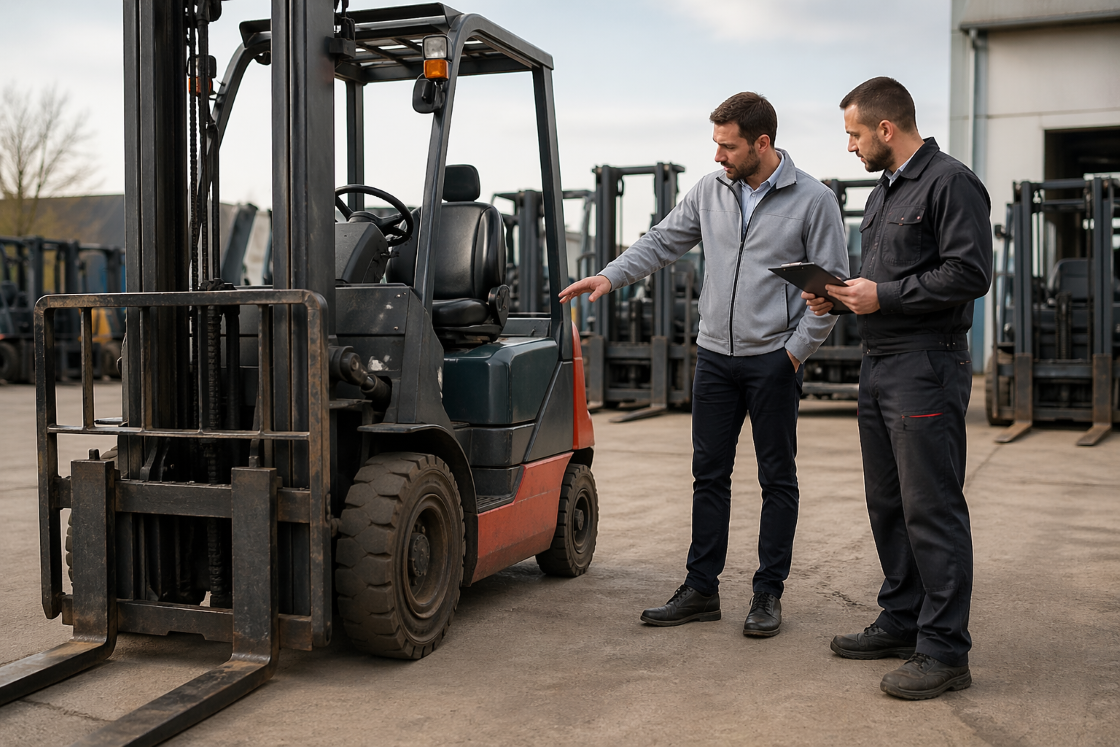
Once you’ve looked at the key components, the next step is a simple walk-around. You don’t need to be technical here. A lot of issues show up just by paying attention to what’s in front of you.
- Start with the mast and lift assembly. This is one of the hardest working parts of the forklift, so wear is normal, but it should still move smoothly. Raise and lower it through its range and watch how it behaves. Any jerking, hesitation, or uneven movement is worth noting. Take a look at the chains as well. They should be properly tensioned, not hanging loose or showing obvious signs of stretch.
- Then move to the forks. They cop a lot of stress over time, so this is where damage often shows up. Check for cracks, especially near the heel where the fork meets the carriage. Look at them side by side to make sure they sit evenly. If one looks slightly lower or more worn than the other, it can affect how loads are carried. Grinding marks or reshaped edges can also be a sign they’ve been repaired in the past.
- Tyres are easy to overlook, but they tell you a lot about how the forklift has been used. Look for even wear across the surface. Flat spots or heavy wear on one side can point to rough use or poor handling. It’s also worth checking that the tyre type suits the work environment, whether that’s indoor concrete or outdoor ground.
- Have a look over the frame and overhead guard next. Small cosmetic marks are normal, but anything more than that deserves a closer look. Dents, cracks, or signs of impact can suggest the forklift has taken a hit at some point. Fresh paint in isolated areas can sometimes be used to cover repairs, so it’s worth paying attention to anything that looks out of place.
- Finally, check for leaks and general condition. Look underneath the machine and around hoses and fittings. Oil or hydraulic fluid where it shouldn’t be is an early warning sign. A forklift that’s been looked after usually shows it in how clean and consistent everything appears.
This part isn’t about finding a perfect machine. It’s about spotting signs of how it’s been treated over time. Instead of leaving it to chance, this is where working with the right supplier makes a real difference. At Heavy Lift Forklifts, every machine is gone over by experienced mechanics before it ever reaches you. That includes everything from engine and hydraulic repairs through to replacing worn tyres where needed. It’s not just a quick check, it’s making sure the forklift is ready to do the job from day one, not something you have to fix once it’s on site.
Service History and Documentation: What You Should Always Ask For
Once you’ve looked over the forklift itself, the next step is just as important. Ask about its history.
A forklift might look clean and run well during a quick check, but the paperwork is what shows how it’s been treated over time. Regular servicing, recorded properly, is one of the clearest signs that a machine has been looked after.
Start by asking for service records. You want to see consistent maintenance, not long gaps followed by a recent quick fix before sale. Things like oil changes, filter replacements, and general servicing should show up at regular intervals. If there’s no record of this, you’re relying on guesswork. It’s also worth checking if any major repairs have been done. That’s not always a bad thing, but it helps to know what’s been replaced and why. A well-documented repair is very different from something that’s been patched up with no history behind it.
Compliance matters as well. A forklift needs to meet safety requirements, and that’s not something you want to sort out after you’ve already bought it. Knowing it’s been checked and meets OHS standards gives you one less thing to worry about.
This is where buying from the right supplier makes things a lot simpler. Instead of chasing paperwork or trying to piece together a history, the work has already been done. For example, if the forklift has been fully serviced and brought up to OHS compliance before sale, you’re starting with a machine that’s ready to go, not one that still needs sorting out.
At the end of the day, you’re not just buying a forklift, you’re buying how it’s been maintained. The paperwork fills in the gaps that you can’t see just by looking at it.
Need help finding a forklift you can rely on? If you’d rather skip the uncertainty, get in touch with Heavy Lift Forklifts. Every used forklift is fully serviced, checked, and OHS compliant before it reaches you, with local support and delivery options available across Melbourne.
Test Driving a Used Forklift (What to Pay Attention To)
A quick look around the forklift only tells you so much. The real test is how it behaves when it’s actually being used. Even a short drive can reveal things you won’t spot standing still.
Start with the basics. Turn it on from cold if you can. It should start without struggling or needing multiple attempts. Listen closely. Unusual knocking, rattling, or high-pitched noises are worth paying attention to straight away.
Once it’s running, take it for a proper drive, not just a slow roll forward and back.
- Acceleration and power should feel steady, not sluggish or jerky
- Braking should be responsive without needing to push hard
- Steering should feel controlled and consistent, not loose or heavy
- Transmission should shift smoothly without delays or jolts
Then move on to lifting.
- Raise and lower the mast through its full range
- Check for smooth movement without hesitation
- Hold a load in the air if possible and watch for any drop
- Tilt the mast forward and back to see how it responds
Pay attention to how everything feels overall. A forklift that’s been looked after usually feels tight and predictable. One that hasn’t can feel rough, noisy, or just “off” in a way that’s hard to ignore.
If you’re able to test it under real working conditions, even better. A forklift can behave very differently once it’s actually lifting weight rather than running empty.
This step is where a lot of hidden issues show up. It’s also where confidence comes from. If the machine runs well here, it’s a good sign you’re on the right track.
And if you’re buying from a supplier that properly prepares their forklifts, a lot of this risk is reduced. A machine that’s already been fully serviced and checked before sale should perform the way you expect when you test it, not surprise you once it’s on site.

Download the How to Buy A Used Forklift guide here >>
Dealer vs Private Seller (Where Most Risk Comes From)
Where you buy the forklift from matters just as much as the forklift itself. Two identical machines can come with very different levels of risk depending on who’s selling them.
Buying from a private seller can look appealing at first. The price is often lower, and the deal can be quick. But what you’re really getting is limited visibility. You’re relying on what you can see on the day and what the seller tells you. Once the forklift leaves their yard, any issues that show up are yours to deal with.
There’s usually no real backup. No support if something goes wrong, no clear service history in many cases, and no guarantee the forklift has been properly checked before sale. It might run fine for months, or it might start causing problems straight away.
Buying from a dealer is a different situation. The upfront cost can be slightly higher, but you’re reducing a lot of unknowns.
- The forklift has typically been inspected before sale
- Servicing is done or brought up to date
- Issues are identified and addressed upfront
- You have someone to go back to if something isn’t right
This is where the difference really shows once the forklift is in use. Instead of reacting to problems, you’re starting with a machine that’s already been looked over properly.
For example, when a forklift is fully serviced and brought up to OHS compliance before it reaches you, you’re not taking the same gamble as a private sale. It’s been checked, prepared, comes with guarantees and warranties and is ready to go straight to work.
There’s also the practical side. Access to a local team for repairs, maintenance, and support makes a big difference over time. If something does come up, you’re not left chasing solutions on your own.
The cheaper option isn’t always the cheaper option once everything is factored in. In most cases, the real question isn’t “where can I save the most money today?” it’s “where am I taking on the least risk for the months ahead?”
Also Read: What is a Counterbalance Forklift?
Should You Buy New or Used?
This is the question most people circle back to before making a decision. There’s no single right answer, but there is a right answer for your situation.
A used forklift usually makes sense when:
- You want to keep upfront costs lower
- The machine won’t be running all day, every day
- You need something quickly without long lead times
- It’s a second or backup unit rather than your main workhorse
A new forklift starts to make more sense when:
- The forklift will be used heavily every day
- Downtime would cause real disruption to your business
- You’re planning to keep it long term
- You want the added certainty of warranty and minimal wear
Where a lot of businesses land is somewhere in the middle. They want the cost savings of used, but without the risk that usually comes with it. That’s where the way the forklift is prepared before sale matters. A properly inspected, fully serviced, and OHS compliant used forklift can give you much of the reliability you’d expect from new, without the same upfront spend. It closes the gap more than most people realise.
Another thing to consider is flexibility. If you’re not completely sure yet, hiring can be a practical option while you figure out what suits your operation. It gives you time to test what works without committing straight away.
At the end of the day, it’s not just about new vs used. It’s about how the forklift will be used, how much downtime you can afford, and how much risk you’re willing to take on. Get those right, and the decision becomes a lot clearer.
Heavy Lift Forklifts
Forklifts For Hire Melbourne >> | Forklifts For Sale Melbourne >>
Our showroom: 826 Mountain Hwy, Bayswater VIC
Call us on: (03) 9762 4965